Why Background Checks Are Taking Longer and Costing More in 2026: Court Redactions, Outages, Staffing Shortages, and Operating Cost Increases
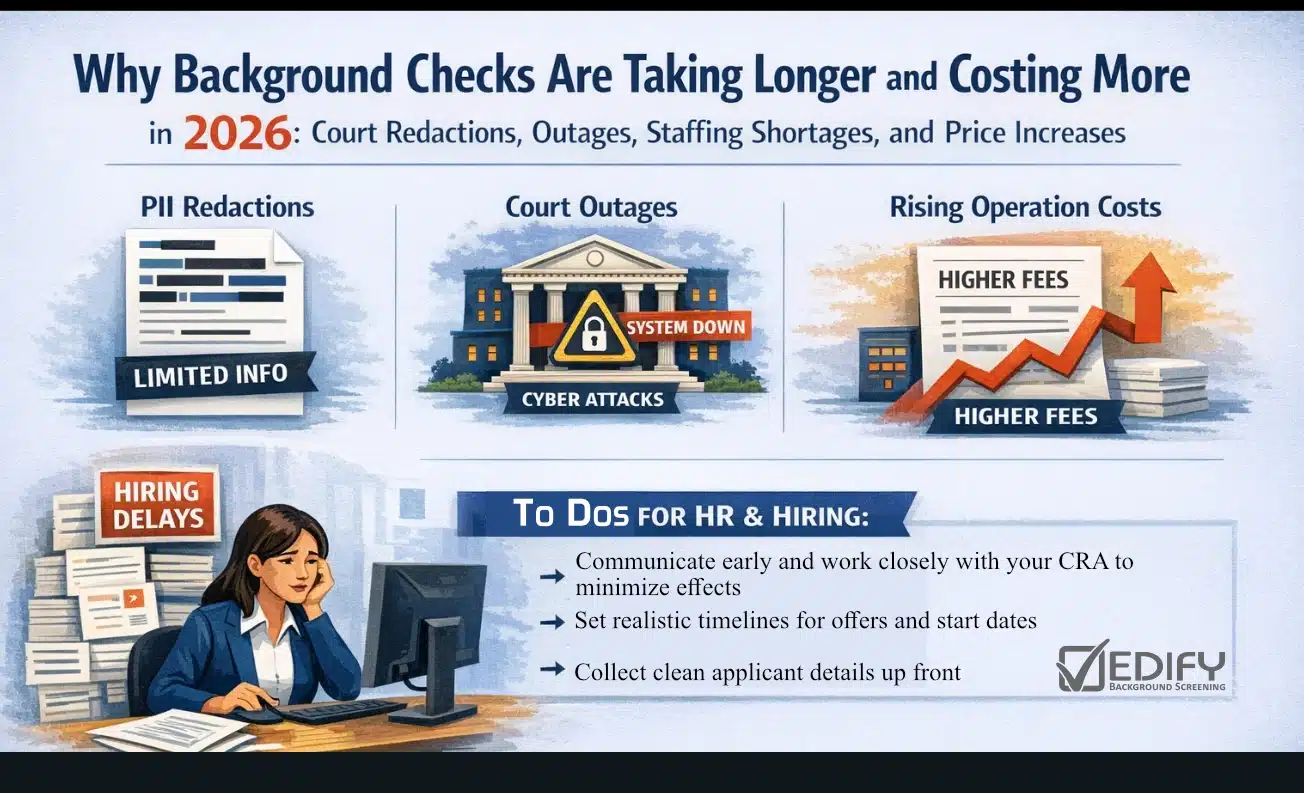
Hiring is harder when your background checks slow down or cost more than last year. In 2026, most of the friction is coming from the court side—PII redactions that limit identifiers, staffing shortages that reduce public hours, and court portal outages after cyber incidents, plus rising pass-through fees and tighter, non-FCRA state rules. If you’re an SMB HR or hiring leader, this guide breaks down what’s changing and how to keep offers moving. If you need a fast primer on process and compliance, start with our FCRA-compliant employment background checks.
Quick Summary
- PII redactions: Several court systems (e.g., California, Michigan, Tennessee, New York, South Carolina, Virginia, and many others) have or are moving to restrict dates of birth, addresses, and other identifiers in public records, slowing identity matching.
- Court operations: Clerk staffing gaps and reduced public hours add wait time for pulls, updates, and certified copies.
- Court outages: Cyber incidents at courts have taken portals offline for weeks, forcing paper workflows and backlog cleanups.
- Costs: Pass-through court fees, paid data access, verifications tolls, and higher operating costs are pushing per-report prices up.
- Compliance: Clean Slate, ban-the-box, and other local rules layer on top of the FCRA, increasing steps and review time.
- Insurance: Insurance costs have skyrocketed for CRAs of the past few years, and after absorbing must of the initial increases, are now having to pass those along to clients.
PII redactions are spreading… causing identity matching to take longer and cost more
Courts in several states have tightened how much personally identifying information shows up in public court indexes and documents. In California, the Hamrick decision interpreting Rule 2.507 triggered broad DOB and driver’s license redactions from online indexes; Michigan court rules similarly require DOB redaction from records available via the internet; South Carolina has removed addresses, and more and more states are following suite. Fewer identifiers mean case file pulls, clerk fees, and more manual steps; to confirm you have the right John A. Smith.
For HR, that looks like additional clerk-assisted searches, alternate-identifier triangulation (address history, AKAs), and sometimes re-checking neighboring counties. Expect more variability by county and case type.
Takeaway: Less PII in public records = more manual research time to confirm true matches and more court fees to pull paper files, especially in California and Michigan, and other states that have virtually eliminated necessary identifies for the public records sources.
Court staffing shortages and reduced public hours slow routine pulls
Many courts report ongoing clerk vacancies and heavier workloads. That translates into longer queues for file pulls, case updates, and certified documents. In some places, courts have publicly reduced counter hours or instituted furlough days to cope with budget cuts.
- Sector surveys note clerk-level staffing strain and efficiency challenges in 2025–2026: Thomson Reuters Institute/NCSC survey and NCSC workforce brief.
- Example: Alameda County Superior Court reduced public hours due to budget cuts and added furloughs, citing statewide trial-court reductions: court notice and follow-up notice.
Takeaway: Fewer clerk hours and fewer hands on deck create predictable slowdowns for county criminal and civil record fulfillment.
Court cyber incidents and portal outages create weeks of downtime
To be crystal clear: we are talking about court system outages, not screening companies. When a court experiences a cyber incident, online access often goes dark and filings revert to paper for weeks. Restoration is phased, and backlogs linger even after the homepage is back up.
- Case in point: the Kansas judicial branch “security incident” in October 2023 led to prolonged disruption and staged restoration of eFiling and public access functions: Kansas Courts incident page and associated coverage from AP (outage) and AP (restoration), plus Government Technology.
- As of this writing there are at least 3 court systems in the US in recovery mode related to recent cyber attacks.
When this happens, county criminal and civil searches are the most affected. The practical move is to set expectations early and communicate with your CRA who will keep you updated on delays and closures.
Takeaway: Court-side outages can add weeks. Plan for no-ETA windows and communicate proactively with hiring managers.
Rising Inputs: court fees, data access, verifications tolls, insurance, and labor
Local courts are also adjusting fees to fund operations, staffing, and modernization. These are pass-through costs. At the same time, vendors’ operating costs—research time, verification tolls, compliance QA, and insurance, have shifted compared with pre-2023 levels, which affects per-report pricing.
- Examples: as of January 1st, 2026 there were over 200 court fee changes withing the past 3 months.
- Insurance market context: cyber and professional lines have been volatile since 2021–2023 surges; and 2024–2025 saw even higher costs with little relief in sight.
- Verifications: many schools and employers route through third-party systems with per-record tolls that are separate from court access fees and almost every third-party service has raised their fees dramatically over the past two years, with some services more than doubling their fee.
Takeaway: Expect more pass-through fees and variable vendor inputs in 2026; budgeting by geography, role type, and volume helps you stay ahead.
Rules beyond the FCRA: Clean Slate and fair-chance patchwork adds steps
On top of the FCRA, you’re dealing with state and local rules that change what can be reported, when you can consider it, and how you notify candidates. Clean Slate expansions automatically seal more records, while ban-the-box and fair-chance rules move criminal history review later in the process and may require individualized assessments and local notices.
- Clean Slate context and state activity: see NCSL’s 50-state database and recent state developments (e.g., Illinois Clean Slate bill update).
- Beyond FCRA reporting limitations: wider adoption of more restrictive reporting rules across dozens of states and jurisdictions are creating additional compliance obligations and taking more time to verify reporting requirements.
Takeaway: More automatic sealing and reporting rules mean extra review steps, more localized notices, and occasionally a re-run to confirm record status.
What you can do now (SMB playbook)
- Front-load identifiers: Collect full legal name, known AKAs, and complete address history at the application stage to offset redactions.
- Budget realistically: Build a pass-through fee buffer for high-volume counties and roles with heavy verification needs; consider small business background checks packaging.
- Communicate SLAs: Explain court-side dependencies to your recruiters and hiring managers to set realistic expectations.
- Map jurisdictions to roles: For multi-state hiring, pre-map Clean Slate and fair-chance rules where your candidates live and where work is performed.
Takeaway: You can’t control courts, but you can control process, sequencing, and communication to keep hiring momentum.
Need predictable ETAs despite court turbulence?
EDIFY builds county coverage with on-site researcher options where available and clear pass-through visibility. Let’s tailor an SMB-friendly package.
FAQ
Q: Are DOB redactions permanent?
A: Some are tied to statewide rule changes (e.g., California Rule 2.507 interpretation; Michigan MCR updates), so don’t expect quick reversals. Plan for ongoing manual identity resolution and modest increases in court and clerk fees.
Q: What can we do to prevent delays for hourly hiring?
A: Submit complete identifiers, allow partial starts for non-safety roles after non-court components clear, and communicate often with your CRA.
Q: Why did my report price increase if my package didn’t change?
A: Pass-through court fees, verifications tolls, and third-party researcher costs can vary by jurisdiction. Ask your CRA to show these line-item costs separately on your billing statement so you can budget.
Q: How do Clean Slate laws affect what shows up?
A: Eligible records are automatically sealed in many states and won’t appear on public-record searches. Most CRA will follow statutory limits and the FCRA on reporting, so make sure to communicate your CRAs policies regarding how Clean Slate laws are incorporated into their reporting systems.
Conclusion
Most 2026 delays and price pressure trace back to courts: redactions, staffing, outages, and fee adjustments, plus more complex local rules on top of the FCRA. With better inputs, smart sequencing, and clear SLAs, you can still hire fast and fair. Ready to stabilize timelines and costs? See our background check pricing.
Compliance Note
- Ensure disclosures, authorizations, and adverse action follow the FCRA, even when local rules add extra steps.
- Apply individualized assessment and timing rules consistent with EEOC guidance and local fair-chance laws.
- When Clean Slate sealing changes a record mid-process, re-verify reportability before making a decision.