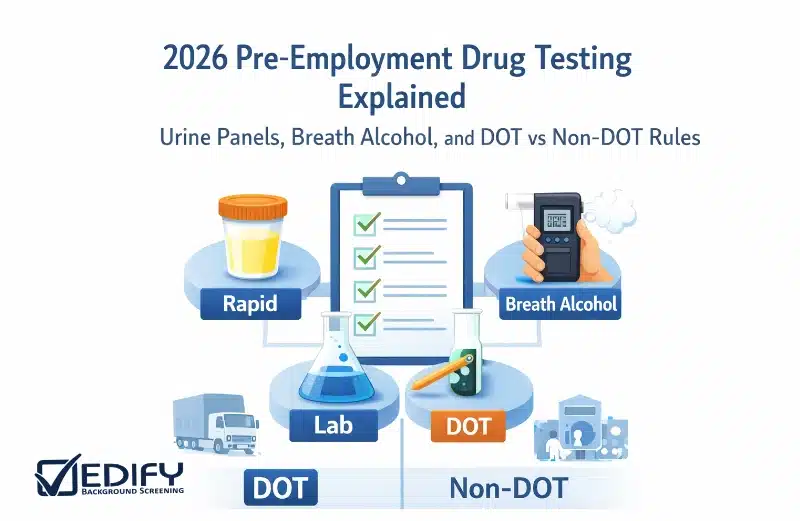
2026 Pre-Employment Drug Testing Explained: Urine Panels, Breath Alcohol, and DOT vs Non-DOT Rules
If you are hiring for roles where safety, judgment, attendance, or public trust matter, pre-employment drug testing is still worth your attention. The hard part is not deciding whether drug testing matters. The hard part is choosing the right test, applying it consistently, and keeping DOT and non-DOT rules from getting mixed up.
That is where a simple, role-based program helps. When you pair drug testing with background checks, you can make faster, more confident hiring decisions without turning your onboarding process into a mess.
Quick Summary
- Rapid urine tests are great when speed matters and you need an initial screen fast.
- Lab-based urine tests give you broader panel choices, cleaner documentation, and confirmed results through a Medical Review Officer, or MRO.
- DOT testing is federally regulated, follows strict procedures, and is not interchangeable with non-DOT testing.
- Non-DOT testing gives you more flexibility, including 4-panel no THC, 5-panel rapid, 9-panel lab, 10-panel expanded, and broader 14-panel options.
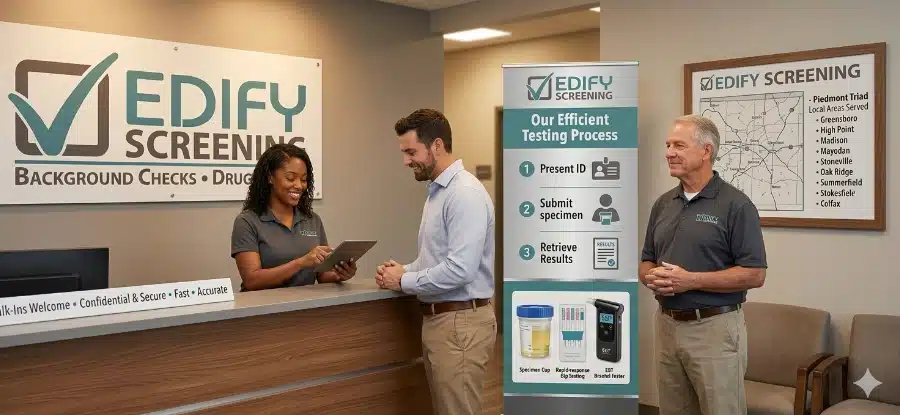
- EDIFY offers both fully integrated background checks plus drug testing, or standalone drug testing only, with access to 30,000+ lab locations nationwide and local walk-in testing in Greensboro and Madison.
Why drug testing still matters right now
Drug testing is not about trying to control people. It is about reducing avoidable risk before someone gets behind the wheel, steps onto a warehouse floor, handles patient care, operates equipment, enters a customer home, or represents your business in a high-trust role.
That matters even more in today’s environment. Marijuana is more common. Meth is still a serious issue in many markets. Prescription painkiller misuse has not disappeared. Illegally made fentanyl and other synthetic opioids have made the broader drug landscape more dangerous and less predictable. For employers, that means you need a policy that matches real-world risk, not wishful thinking.
It also means you should stop using one blanket testing approach for every position. A front-office hire, a forklift operator, a CDL driver, and an in-home technician do not all carry the same level of exposure for your company. Your testing program should reflect that.
Bottom line: Drug testing still matters because one bad hiring decision can turn into an accident, claim, lost account, or reputation hit faster than most employers expect.
Rapid urine tests vs. lab urine tests
The biggest choice most employers make is not DOT vs non-DOT at first. It is rapid versus laboratory testing.
Rapid urine testing makes sense when you need an answer quickly. It is popular for fast-moving hiring environments, same-day decisions, and local walk-in testing. A 5-panel rapid test is often the starting point because it covers the common basics and can help you keep your process moving.
Lab-based urine testing makes sense when you need a broader panel, better documentation, stronger defensibility, or a chain-of-custody process that is easier to stand behind. Lab testing is also the better fit when non-negative results need confirmation and review by an MRO before you act.
Here is the practical way to think about common urine panel choices:
- 4-panel no THC: useful when you want to exclude marijuana from the panel but still screen for cocaine, opiates, amphetamines, and PCP.
- 5-panel rapid: a fast, common option for general pre-employment screening.
- 9-panel lab: a stronger fit when you want more visibility into prescription-drug misuse and higher-risk behavior.
- 10-panel expanded: helpful for safety-sensitive or higher-liability roles where expanded opiates, oxycodone, 6-AM, MDMA, or other added analytes matter.
- 14-panel lab: best when you want broader visibility for high-trust, high-risk, or zero-tolerance environments.
You do not need the biggest panel for every job. You need the panel that fits the role, your written policy, and the laws that apply where you hire.
Bottom line: The right panel is not the one with the most boxes checked. It is the one that makes sense for the job in front of you.
DOT vs non-DOT, where employers get confused
This is where a lot of employers get tripped up. DOT testing is for covered safety-sensitive transportation roles and follows federal procedures. Non-DOT testing is employer-directed and shaped by your policy, your industry, and state law.
That means a true DOT urine drug test is not just “another 5-panel.” Under DOT rules, the laboratory tests for five federally defined drug classes. But those categories include multiple analytes and metabolites, which is why the label “5-panel” can sound simpler than the process really is. Just as important, DOT collections, forms, labs, review steps, and reporting rules are tightly controlled.
Non-DOT testing gives you more room to tailor the panel. You can choose broader options. You can choose no-THC options in states or industries where that makes sense. You can also build role-based packages instead of forcing every applicant through the same screen.
What you should not do is blur the line. A non-DOT expanded test may use a strong chain-of-custody process and feel similar operationally, but it is still not the same as a federally regulated DOT test. If you hire CDL drivers or other DOT-covered workers, keep that program separate and clean.
Need help choosing the right setup?
If you are not sure whether you need a 4-panel no THC, a 9-panel lab, a 10-panel expanded test, or a true DOT collection, start with the role first. Then match the test to the risk, not the other way around. If you also want the screening side aligned, take a look at our small business background checks options or see our background check pricing.
Bottom line: DOT and non-DOT are not interchangeable. One is a federally regulated program. The other is a policy decision you control.
Where breath alcohol testing fits
Urine drug testing and breath alcohol testing solve different problems. Urine testing helps detect recent drug use through metabolites. Breath alcohol testing helps you measure current alcohol concentration at the time of testing. That makes breath alcohol especially useful when timing matters.
For DOT-covered workers, alcohol testing comes with its own rules and procedures. For example, FMCSA pre-employment testing is for controlled substances only, not alcohol. Alcohol testing usually becomes relevant in other situations such as reasonable suspicion, post-accident, random, return-to-duty, and follow-up testing. Some DOT-regulated employers may conduct pre-employment alcohol testing in limited circumstances, but those rules are specific and need to be handled correctly.
For non-DOT employers, breath alcohol testing is often a smart addition when you need a defensible process for post-accident events, reasonable suspicion, or policy-based testing. It is also useful when you want a cleaner answer than a supervisor’s opinion alone.
Bottom line: Breath alcohol testing is not a side note. In the right situations, it is one of the most useful tools you have for protecting your people and your company.
How to build a smarter testing program for your business
If you run a small or mid-sized business, the easiest mistake is overcomplicating the program. You do not need a giant policy manual to get started. You need a few clear decisions made upfront.
- Separate DOT-covered roles from non-DOT roles.
- Decide whether your non-DOT policy includes or excludes THC.
- Choose which jobs get rapid testing and which get lab-based testing.
- Define when you use post-accident, reasonable suspicion, random, and return-to-duty testing.
- Apply the same standard to the same job category every time.
Here is what that looks like in real life:
Warehouse, manufacturing, or equipment roles: a 9-panel or expanded 10-panel usually makes more sense than a bare-bones screen because the safety stakes are higher.
CDL and other DOT-covered roles: use a true DOT urine process and keep breath alcohol procedures aligned with the DOT event that triggered the test.
Office, professional, or lower-risk roles in changing marijuana-policy environments: a 4-panel no THC or 9-panel no THC may be the better fit if that matches your policy and applicable law.
EDIFY’s model is built for that kind of flexibility. You can order drug testing as part of a fully integrated screening program, or you can use drug testing as a standalone service. You also get nationwide coverage through 30,000+ lab locations, plus local walk-in access for employers who want no-wait, no-appointment testing support in Greensboro and Madison.
Bottom line: The best program is simple, role-based, documented, and easy for your team to use consistently.
Why employers like integrated screening with EDIFY
When your drug testing and hiring screening happen in separate systems, things get clunky fast. Someone forgets a form. Someone sends an applicant to the wrong place. Results arrive in different places. Hiring managers start making decisions from incomplete information. That is how delays and mistakes creep in.
With EDIFY, you can keep the process tighter. We offer integrated drug testing with employment screening, plus standalone drug testing when that is all you need. That lets you support different workflows across your organization without rebuilding the process every time a new position opens.
That matters whether you are hiring one person this week or building a repeatable program across multiple departments and locations. It also matters locally. If your team needs fast access to testing, our walk-in locations in Greensboro and Madison make it easier to get applicants tested without the usual friction.
Bottom line: When the process is easier for your team and easier for the applicant, it usually gets done faster and with fewer mistakes.
FAQ
Q: Is a DOT drug test the same as a 10-panel drug test?
A: No. A true DOT test follows a federally defined panel and federally required procedures. A 10-panel test is usually a broader non-DOT option unless it is clearly identified otherwise. Your next step is to separate DOT-covered and non-DOT roles before you order anything.
Q: What is the difference between a rapid urine test and a lab urine test?
A: Rapid tests are built for speed, with negative results available usually within minutes. Lab tests are built for broader panel options, documented chain of custody, confirmation testing, and MRO review. In both rapid and lab tests, non-negative results are confirmed by a laboratory and reviewed by an MRO before being reported to you.
Q: Should my company still test for marijuana?
A: That depends on the role, your policy, and state law. For DOT-covered safety-sensitive roles, marijuana testing is still required under federal rules. For non-DOT roles, some employers keep THC in the panel and others do not. Your next step is to review your policy by job category instead of using one rule for everyone.
Q: When should an employer use breath alcohol testing?
A: Breath alcohol testing is especially useful for safety-sensitive positions, post-accident, reasonable suspicion, return-to-duty, follow-up, and some DOT-triggered events. Your next step is to define those trigger points in writing before an incident happens.
Q: Can I order drug testing without bundling a background check?
A: Yes. EDIFY offers both standalone drug testing and integrated screening solutions. Your next step is to decide whether this hiring flow needs drug testing only or a combined screening package.
Q: How do I choose between a 4-panel, 5-panel, 9-panel, 10-panel, or 14-panel test?
A: Start with the job. Lower-risk roles may only need a simple screen. Safety-sensitive or higher-liability roles usually justify a broader panel. Your next step is to match the panel to the actual exposure the role creates for your business.
Conclusion
Pre-employment drug testing does not have to be confusing. If you keep DOT and non-DOT separate, match the panel to the role, and build a process your team can actually follow, you will make safer and faster hiring decisions. When you are ready to tighten up the full screening side too, see our background check pricing and build a program that fits the way you hire.
Compliance Note
- Keep DOT and non-DOT testing programs separate. Do not label a non-DOT expanded panel as a true DOT test.
- Apply testing standards consistently by job category, and make sure your criteria are job-related and tied to real business risk.
- If you also rely on a background report when making the hiring decision, follow the required pre-adverse and adverse action steps before you finalize it.
Related Terms
Authoritative Sources