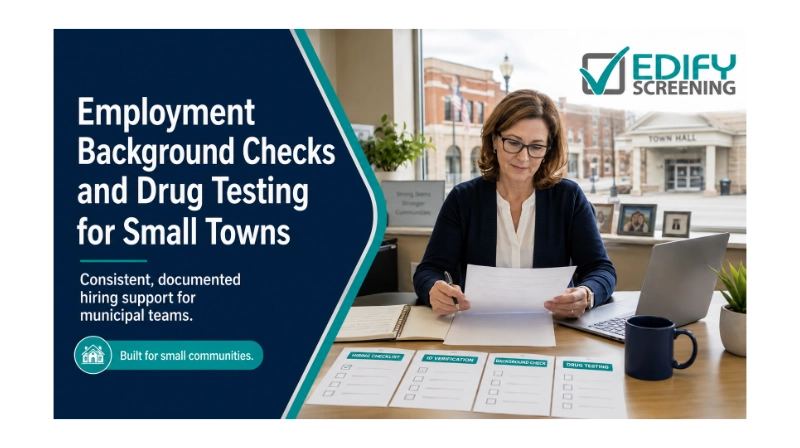
Employment Background Checks and Drug Testing for Small Towns
Small towns have big hiring responsibilities, even when the staff is small and everyone wears several hats. A town manager, clerk, or administrator may be hiring for public works, utilities, parks and recreation, finance, code enforcement, office support, or driving-related positions.
Each of those roles carries a different kind of risk. Some employees handle public funds. Some drive town vehicles. Some enter private property. Some work around children, residents, or sensitive records.
That is why small towns need more than an informal local police check. They need an employment-focused background check and drug testing process that is consistent, documented, and built for hiring decisions.
EDIFY helps small towns move from informal screening to professional, employment-purpose background checks and drug testing workflows designed to support safer hiring, better documentation, and stronger compliance awareness.
Quick Summary
- A local police check is not the same thing as a complete employment background check.
- Small towns should match screening packages to the job duties of each position.
- Background checks used for hiring generally require proper disclosure, authorization, applicant rights information, and adverse action procedures.
- Drug testing should be tied to a written workplace policy, testing reason, collection process, confidentiality, and result-handling steps.
- Working with a Consumer Reporting Agency, also called a CRA, helps towns create a more consistent and documented hiring process.
Why Small Town Hiring Carries Real Risk
Small towns may not have large HR departments, but they still have serious public responsibilities. A hiring mistake can affect resident safety, public trust, town operations, and the reputation of local government.
Think about the difference between a finance clerk, a utility worker, a public works employee, and a parks and recreation staff member. One may handle public funds. One may enter homes or private property. One may operate town vehicles or equipment. One may work near children or community events.
Takeaway: Small-town hiring should be based on the risk of the role, not just the size of the town.
A “we know them” hiring culture can feel natural in a close community, but it can also create blind spots. A consistent screening process helps town leaders treat applicants fairly, document decisions, and reduce the chance of informal or inconsistent hiring practices.
Why a Local Police Check Is Not a Complete Employment Background Check
Many small towns naturally think first about asking the local police department to run a criminal record check. That may feel convenient, especially when the police department is part of the same municipal structure.
But a local or state criminal search is not the same thing as a complete employment background check. A local search may miss records from other counties, other states, federal courts, prior addresses, aliases, driving history, employment history, education history, professional licenses, or sex offender registry sources.
A professional employment background check may include several searches, depending on the role:
- Social Security number trace and address history
- County criminal court searches
- State criminal repository searches, where available
- National criminal database searches
- Federal criminal court searches
- Sex offender registry searches
- Motor vehicle records for driving-related positions
- Employment verification
- Education verification
- Professional license verification
- Drug and alcohol testing
Takeaway: A police check may show part of the picture, but employment screening usually needs a broader, job-related process.
The FTC explains that when an employer uses a company that compiles background information for employment purposes, those reports are generally consumer reports under the Fair Credit Reporting Act, also called the FCRA. That means the hiring process needs to follow specific rules around permission, use, and applicant rights.
Employment Screening Has to Follow Employment Rules
Law enforcement databases are designed for public safety and legally authorized law enforcement purposes. They are not built to manage an employment screening workflow.
When a town uses background information to make hiring decisions, it generally needs a process that includes proper disclosure, written authorization, employment-purpose reporting, applicant rights information, and a compliant adverse action process if background information may affect the decision.
The FTC and EEOC both provide guidance for employers that use background information in personnel decisions. Employers must also avoid using background information in a way that violates equal employment opportunity laws.
Takeaway: The issue is not just what information is found. It is also how the town gets it, reviews it, documents it, and uses it.
A Consumer Reporting Agency, or CRA, helps support the employment screening process by providing reports intended for permissible employment use. A CRA-supported workflow can also help with disclosure and authorization support, applicant rights information, documentation, and adverse action process guidance.
Need to tighten up your town’s hiring process?
EDIFY helps small towns build practical, position-based screening programs for municipal employees, including background checks, MVR checks, employment-purpose reports, and drug testing options.
Learn more about FCRA-compliant employment background checks.
How a CRA Helps Protect the Town, the Police Department, and the Applicant
Using a CRA helps keep the police department from being placed in the role of employment screening provider. Police staff should not have to interpret hiring risk, manage applicant authorizations, decide whether a record is job-related, or support adverse action steps.
Those responsibilities belong in a structured employment screening process. Keeping those roles separate protects the police department, the town, and the applicant.
Takeaway: A CRA helps separate law enforcement work from employment decision-making.
This separation also reduces confusion about the purpose of the search, the source of the information, and how the information should be used. That matters in small communities where applicants may know town staff, elected officials, or police personnel personally.
What Small Towns Should Include in a Position-Based Screening Program
Not every municipal role needs the same background check. A good screening program should start with the job duties and then match the screening package to the risk of the position.
For example, a finance clerk or treasurer role may require a different screening package than a seasonal parks employee. A public works employee who drives town vehicles may need a motor vehicle record check. A utility employee entering private property may need broader criminal history coverage. A role involving children or vulnerable residents may call for sex offender registry searches and other role-specific checks.
Takeaway: The best small-town screening programs are consistent by role, not identical for every employee.
Here is a simple way to think about it:
- Town clerk, finance, or administration: identity history, criminal searches, possible employment or education verification, and role-specific financial trust considerations where legally appropriate.
- Public works and utilities: criminal searches, MVR checks for driving roles, and drug testing where tied to policy and safety needs.
- Parks and recreation: criminal searches, sex offender registry searches, and youth-safety considerations when working around children.
- Code enforcement or inspection roles: identity verification, criminal searches, and screening tied to public contact or property access.
- Supervisory or department head roles: broader screening that may include employment, education, license, or credential verification depending on the position.
For smaller municipalities with limited HR support, EDIFY can help create repeatable packages so staff do not have to rebuild the process every time they hire.
Explore small business background checks for smaller teams and organizations that need a practical screening workflow.
Drug Testing for Municipal Employees Should Be a Workplace Process, Not a One-Off Test
Drug testing is not just about sending someone to a collection site. A good workplace drug testing program should consider the role, the reason for testing, written policy language, collection procedures, laboratory standards, result reporting, confidentiality, and next steps.
For small towns, drug testing may be considered for certain municipal roles, especially where employees drive, operate equipment, work in safety-sensitive environments, or respond after accidents. Some positions may also be subject to federal Department of Transportation drug and alcohol testing rules if they fall under DOT-regulated safety-sensitive transportation work.
Takeaway: Drug testing should be based on policy, job duties, applicable law, and consistent procedures.
Common workplace testing categories may include:
- Pre-employment testing
- Random testing, where appropriate
- Reasonable suspicion testing
- Post-accident testing
- Return-to-duty or follow-up testing, where applicable
SAMHSA notes that workplace drug testing programs can raise legal issues, including privacy, discrimination, and wrongful discharge concerns. That is why small towns should work with legal counsel when building or updating drug testing policies.
Adverse Action: The Step Small Towns Cannot Afford to Miss
Adverse action is one of the most important compliance steps in employment background screening. In plain English, it means the employer may decide not to hire someone, withdraw a conditional offer, or take another negative employment action based in whole or in part on the background check.
Before taking final adverse action based on a background report from a CRA, the employer generally must give the applicant a copy of the report and a summary of their rights under the FCRA. The applicant should have a reasonable opportunity to review the report and dispute information that may be inaccurate or incomplete.
Takeaway: If background check results may affect the hiring decision, do not skip the adverse action process.
This step is easy to miss when a town handles screening informally. A CRA-supported process helps town staff follow a more documented workflow, which protects both the applicant and the municipality.
To better understand this term, see EDIFY’s glossary explanation of adverse action.
Why Small Towns Choose EDIFY
EDIFY Screening helps municipalities move from informal background checks to professional, employment-focused screening programs. That can make a major difference for small towns where the same person may be handling hiring, payroll, records, council packets, and public inquiries.
Working with EDIFY gives small towns access to broader screening coverage than a local police check, employment-purpose reports from a CRA, support with authorization and disclosure processes, FCRA-focused adverse action guidance, drug testing options, position-based packages, consistent documentation, and a better applicant experience.
Takeaway: EDIFY helps small towns build screening programs that are practical, professional, and easier to manage.
The goal is not to make hiring harder. It is to make hiring safer, clearer, and more consistent for the people serving your community.
FAQ: Employment Background Checks and Drug Testing for Small Towns
Q: Can a small town use the local police department for employee background checks?
A: A town may be tempted to use the local police department because it feels familiar and convenient. The problem is that police checks are usually not designed to serve as a complete employment screening process. A CRA can provide employment-purpose reports, broader search options, applicant authorization support, and adverse action process guidance. A good next step is to compare your current process against a CRA-supported employment screening workflow.
Q: Is a local criminal record search enough for municipal hiring?
A: Usually, no. A local criminal search may miss records from other counties, states, federal courts, or prior addresses. It may also leave out driving records, employment verification, education verification, license verification, or drug testing. Start by identifying the risks of each position, then match the screening package to the job duties.
Q: What background checks should a town run on public works employees?
A: Public works roles often require a mix of criminal history screening, identity and address history, MVR checks for driving positions, and drug testing where appropriate under policy and law. If the employee drives commercial vehicles or performs DOT-regulated safety-sensitive work, DOT rules may apply. Review the job description before choosing the screening package.
Q: Should town employees be drug tested?
A: Drug testing should be tied to a written workplace policy, job duties, safety concerns, and applicable federal, state, and local law. Some towns use pre-employment, reasonable suspicion, post-accident, random, or return-to-duty testing depending on the role. Before launching or changing a program, review your policy with legal counsel and use a consistent testing process.
Q: What is adverse action in a municipal hiring process?
A: Adverse action is when a town may decide not to hire someone, withdraw a conditional offer, or take another negative employment action based in whole or in part on a background report. The FCRA generally requires specific notices, a copy of the report, rights information, and time for the applicant to review or dispute the report before a final decision. Review your process before making any decision based on background results.
Q: Why should a town use a Consumer Reporting Agency for employment screening?
A: A CRA provides reports designed for permissible employment use and helps support a more consistent screening workflow. This can reduce the administrative burden on town staff, keep police departments out of the employment screening role, improve documentation, and give applicants a clearer process. To get started, build screening packages around your town’s actual job categories.
The Bottom Line
Your local police department plays an important role in public safety. But employment screening requires more than a local criminal search.
Small towns need a process that is broader, more consistent, and designed for hiring decisions. By working with a CRA like EDIFY, towns can make better hiring decisions, protect the community, support compliance awareness, reduce administrative burden, and create a fairer process for applicants.
Takeaway: Small towns do not need a complicated HR department to build a better screening process. They need the right workflow, the right searches, and the right partner.
To discuss screening options for your municipality, see EDIFY’s background check pricing or contact EDIFY Screening for help building a practical municipal screening program.
Compliance Note
- When using a third-party employment background check, towns should follow FCRA disclosure, authorization, and adverse action requirements.
- Drug testing policies should be reviewed for federal, state, local, and role-specific requirements before implementation.
- This article is for general educational purposes only and is not legal advice. Municipal employers should consult qualified legal counsel about their specific obligations.