Which Background Check Company Should I Use for My Business?
Choosing a background check company can feel harder than it should.
You search online, see a handful of big names, compare a few prices, and then realize every provider says they are fast, accurate, compliant, and easy to use. That does not help much when you are the one responsible for protecting your business, your employees, your customers, and your applicants.
This guide is written for small and medium-sized employers, meaning businesses and organizations with roughly 10,000 employees or fewer. If you are a business owner, HR professional, hiring manager, or nonprofit leader, the goal is simple: help you match the right background check company to the way your organization actually hires.
If you are looking for practical, role-based support, EDIFY offers small business background checks designed for employers that want online ordering without losing access to real human help.
Quick Summary
- The best background check company depends on your hiring volume, support needs, role risk, budget, and compliance workflow.
- Large CRAs can be a strong fit for enterprise, global, high-volume, or highly automated hiring programs.
- Smaller employers should pay close attention to customer support, responsiveness, pricing clarity, domestic processing, and whether reports are verified before they are used.
- Do not choose a provider based only on speed or brand recognition. Choose the service model that fits your business.
1) Start With Fit, Not Brand Name
There is no single background check company that is best for every employer.
A company hiring 2,000 people a month needs a different screening partner than a business hiring five people this quarter. A national employer with a full HR compliance team may want automation, integrations, dashboards, and enterprise workflows. A smaller employer may need help choosing the right package, understanding delays, reviewing report findings, and handling adverse action correctly.
Takeaway: The right background check company is the one whose strengths match your hiring process, not just the one with the most recognizable name.
Before you compare providers, ask yourself:
- How many background checks do we run each month or year?
- Do we need a self-service platform, live support, or both?
- Are we hiring for basic roles, safety-sensitive roles, financial roles, driving roles, or positions with access to homes, clients, children, or vulnerable people?
- Do we understand our FCRA responsibilities, or do we need guidance?
- Will we need help if a report comes back with a possible criminal record, delay, dispute, or adverse action issue?
2) Make Sure the Provider Is Appropriate for Employment Screening
Not every online background check website is appropriate for hiring.
Employment background checks are usually considered consumer reports when they are prepared by a third-party company for employment purposes. The Federal Trade Commission explains that employers using a third-party company to compile background information must follow the Fair Credit Reporting Act, commonly called the FCRA. You can read the FTC’s employer guidance here: Using Consumer Reports: What Employers Need to Know.
That means you should be careful with people-search websites, instant lookup tools, or public-record search sites that are not designed for employment use. Even if the information looks useful, it may not be appropriate for a hiring decision.
Takeaway: If you are using background information to make hiring decisions, choose a provider that operates as a Consumer Reporting Agency for employment screening.
The Consumer Financial Protection Bureau has also warned that employers generally cannot use third-party background dossiers, scores, or similar reports for employment decisions without following the FCRA. See the CFPB’s circular here: CFPB Circular 2024-06.
3) Compare Service Models, Not Just Features
Most background check companies offer some combination of criminal records, identity searches, motor vehicle records, employment verification, education verification, drug testing, and candidate portals.
Those features matter, but the service model matters just as much.
For smaller employers, the real question is often not, “Can this company run a background check?” The better question is, “Will this company support us when something is confusing, delayed, disputed, or role-specific?”
Takeaway: Software is helpful, but support matters when hiring decisions get complicated.
Here are the main provider types employers usually compare:
- Large enterprise CRAs: Often strong for scale, automation, integrations, global programs, and high-volume hiring.
- Self-service platforms: Often useful for employers that are comfortable ordering standardized packages online with minimal guidance.
- Human-supported screening firms: Often a better fit for employers that want online ordering but still need practical guidance, custom packages, and responsive support.
- People-search websites: Usually not appropriate for employment decisions unless the provider is operating as a CRA for that employment purpose.
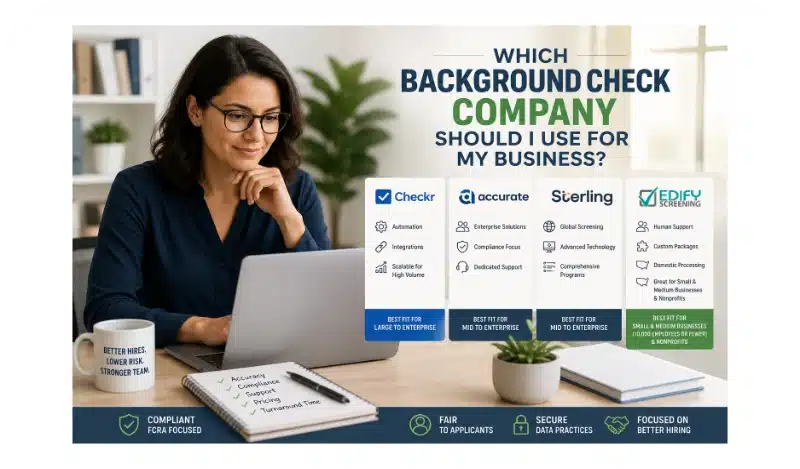
4) Provider Fit Comparison: Checkr, Accurate, Sterling, and EDIFY Screening
Use this table to match each provider’s general strengths to your actual hiring situation. This is not a ranking. It is a fit guide.
| Provider | Best-fit business size or profile | Volume characteristics | Customer support considerations | Pricing style | Processing and outsourcing question | Buyer takeaway |
|---|---|---|---|---|---|---|
| Checkr | Often a stronger fit for larger, high-growth, tech-forward, platform-based, or enterprise employers with standardized hiring workflows. | Better fit when hiring is repeatable, automation-friendly, and steady enough to benefit from platform workflows. | Smaller employers should ask how much live human support is available for their account size versus help-center, chat, chatbot, or ticket-based support. | Checkr publishes package pricing online, with packages starting at $29.99 according to its public pricing page. See Checkr pricing. | Ask where customer support, verification work, and report processing are handled. | Worth evaluating when automation, integrations, and scale matter more than hands-on guidance. |
| Accurate Background | Often a stronger fit for larger enterprise, regulated, or more structured employers. | Better fit for recurring volume, broader screening programs, integrations, or formal HR workflows. | Ask whether your account size qualifies for live support, dedicated contacts, or responsive account management. | Often sales-led or quote-based depending on scope. See Accurate enterprise background checks. | Ask where report processing, candidate support, and verification work are handled. | Worth evaluating for larger programs, but smaller employers should confirm that the service model fits low-volume hiring and support needs. |
| Sterling | Often a stronger fit for mid-sized, large, enterprise, or global, with complex HR and compliance needs. | Stronger fit for high-volume, global, or heavily structured hiring programs. | Ask whether smaller or lower-volume accounts receive dedicated support or general support access. | Typically quote-based or sales-led depending on scope. | Ask how domestic and international processing, support, and verification workflows are handled. | Strong option to evaluate for enterprise-style screening, but it may be more infrastructure than smaller employers need. |
| EDIFY Screening | Small and medium-sized businesses with roughly 10,000 employees or fewer, plus nonprofits, that want online ordering with human support. | Good fit for low to mid-volume employers and scalable for growing organizations that want custom packages instead of one-size-fits-all screening. | Dedicated human support is part of the service model, especially when questions come up around package setup, court delays, disputes, adverse action, or report details. | Role-based and custom package options, with prices starting at $24.95. See EDIFY background check pricing. | EDIFY Screening does not outsource background check processing to foreign countries. | Good fit when support, responsiveness, domestic processing, custom packages, and practical guidance matter as much as online convenience. |
TAKEAWAY: The takeaway is not that one provider is better for every business. Larger CRAs may be a strong fit for employers with high hiring volume, global screening needs, advanced automation requirements, or internal HR teams that can manage more of the process. Smaller employers should focus on whether the provider’s service model matches their need for responsiveness, guidance, and hands-on support.
5) Why Customer Support Should Be Part of the Buying Decision
Background checks are not always plug-and-play.
A report may be delayed because a court requires manual research. A candidate may dispute information. A database search may show a possible match that needs to be verified. A hiring manager may want to know whether a record is job-related. An employer may need to send pre-adverse action notices before making a final decision.
If your provider is hard to reach, those issues can turn into hiring delays, frustrated candidates, and unnecessary risk.
Takeaway: Smaller employers should not assume they will receive the same support experience as a large enterprise account.
Before choosing a provider, ask:
- Will we have a dedicated contact?
- Can we speak with a real person when a report needs explanation?
- How are urgent questions handled?
- Do smaller accounts receive the same response channels as larger accounts?
- Will someone help us build packages by role?
6) Do Not Overbuy or Underbuy Your Background Checks
One of the biggest mistakes smaller employers make is buying the wrong package.
Some employers underbuy by choosing the cheapest instant search and assuming it covers everything. Others overbuy by running the same large package on every role, even when the job duties do not require it.
A better approach is to build screening packages around job risk.
Takeaway: The best background check package is based on the role, not just the applicant.
For example:
- Basic office or entry-level roles: May need identity verification, criminal search coverage, and employment-purpose compliance steps.
- Driving roles: May need a motor vehicle record search.
- Financial or leadership roles: May need employment verification, education verification, civil records, or credit-related screening where legally appropriate.
- Roles entering homes or serving vulnerable populations: May need broader criminal history coverage, sex offender registry searches, and more frequent re-screening policies.
- Regulated or licensed roles: May need credential verification, sanctions searches, or industry-specific checks.
For general employment screening needs, EDIFY’s FCRA-compliant employment background checks can be tailored to the type of role, level of risk, and hiring workflow your business uses.
7) Be Careful With “Instant Nationwide Background Checks”
Instant database searches can be useful, but they are not the same thing as a complete, verified background check.
Criminal records are spread across thousands of courts, agencies, and jurisdictions. Databases can help point researchers toward possible records, but the information may be incomplete, outdated, missing identifiers, or missing final dispositions. That is why employers should ask whether potential criminal database hits are verified at the originating source before being reported or used.
Takeaway: Fast is helpful, but verified is what matters when a report may affect someone’s job.
This is especially important for smaller employers because one bad decision can have an outsized impact. You do not want to reject a candidate based on unverified information, and you do not want to miss relevant records because the package was too thin.
8) Know the Compliance Basics Before You Order
A good background check company can support your process, but it cannot make your hiring decisions for you.
At a minimum, employers should understand that employment background checks often require proper disclosure, written authorization, permissible purpose, fair use of the report, and adverse action steps when a report may negatively affect a hiring decision.
The FTC and EEOC explain that employers must follow federal rules when using background information for employment decisions. The EEOC also advises employers to consider whether criminal history information is job-related and consistent with business necessity. You can review the EEOC guidance here: EEOC guidance on arrest and conviction records.
Takeaway: Compliance is not just a form. It is the workflow you follow before, during, and after the background check.
Common compliance questions to ask your provider include:
- Do you provide disclosure and authorization support?
- Do you support pre-adverse and final adverse action workflows?
- Do you provide the candidate with required report copies and rights notices when applicable?
- Do you help explain disputes and reinvestigations?
- Do you flag state or local reporting limitations that may affect what can be reported?
- Do you explain where employer responsibility begins and provider responsibility ends?
9) Questions to Ask Before Choosing a Background Check Company
Before you sign up with any background check provider, ask practical questions that reveal whether the service model fits your business.
Takeaway: Better questions lead to better provider decisions.
- Are you a Consumer Reporting Agency for employment purposes?
- Do your reports support FCRA employment use?
- Do you work with employers our size?
- What kind of support will we receive as a smaller account?
- Will we have a dedicated contact or only general support access?
- Where is report processing handled?
- Do you outsource any processing or verification work outside the United States?
- Do you verify criminal database hits at the source?
- Can we build different packages for different roles?
- Are court fees, DMV fees, school fees, employment verification fees, or third-party access fees included or passed through?
- How do you handle candidate disputes?
- Do you support adverse action workflows?
- How quickly can we reach a real person when we need help?
10) So, Which Background Check Company Should You Use?
Use your hiring situation as the filter.
If you are a large employer with high-volume, repeatable, heavily automated, or global hiring needs, a larger CRA such as Checkr, Accurate, or Sterling may be worth evaluating. Their platforms and infrastructure may fit companies with strong internal HR systems and the staff to manage a more self-directed process.
If you are a small or medium-sized business, or a nonprofit, and you want online ordering with practical human support, EDIFY Screening may be a better fit. This is especially true if you want help building role-based packages, understanding report delays, handling adverse action steps, and working with a provider that does not outsource background check processing to foreign countries.
Takeaway: The best choice is the provider whose strengths match your volume, risk, support needs, and hiring workflow.
When you are ready to compare options, start with your roles, your hiring volume, and your support expectations. Then choose the provider that fits those needs, not just the one with the biggest name.
Need a practical starting point?
If you want help matching background check packages to your roles and hiring process, you can review EDIFY’s background check pricing or talk with our team about what level of screening makes sense for your business.
FAQ: Choosing a Background Check Company
What is the best background check company for a small or medium-size business?
The best background check company for a small or medium-size business is usually one that provides employment-purpose screening, clear pricing, responsive support, role-based package options, and help with FCRA-related workflows. A large automated platform may work well for some employers, but others may need more hands-on support. Start by matching the provider’s service model to your hiring volume and internal HR experience.
Can I use an instant online background check for hiring?
Be careful. Some instant online searches are not designed for employment use. If you are using a third-party report to make a hiring decision, you generally need a provider that supports employment screening under the FCRA. Ask whether the provider is a Consumer Reporting Agency for employment purposes before ordering.
Should I choose the cheapest background check provider?
Not automatically. Price matters, but the cheapest option may not include the searches, verification, support, or compliance workflow you need. Ask what is included, what fees may be added, whether criminal hits are verified, and whether you can reach support when something is unclear.
Do large background check companies support smaller employers?
Some do, but the level of support can vary by provider, account size, volume, and service model. Smaller employers should ask whether they will receive live help, a dedicated contact, or general support access before choosing a large CRA.
Why does domestic processing matter in background screening?
Background checks involve sensitive personal information and time-sensitive hiring decisions. Some employers prefer providers that keep processing domestic because they want clearer accountability, easier communication, and a more direct service relationship. Ask every provider where report processing, candidate support, and verification work are handled.
What should I ask before signing up with a background check company?
Ask whether the provider supports employment-purpose FCRA screening, verifies criminal database hits, offers adverse action support, works with your company size, provides live human help, explains pass-through fees, and handles processing domestically or offshore. These questions will help you compare fit, not just features.
Compliance Note
- Employment background checks may be consumer reports under the FCRA. Employers should use proper disclosure, authorization, permissible purpose, and adverse action procedures.
- If a background check may negatively affect a hiring decision, employers generally need to follow pre-adverse and final adverse action steps before making the decision final.
- State and local laws may limit when and how employers can ask about, consider, or act on criminal history. Consult qualified legal counsel for legal advice specific to your organization.