Synthetic Identities, Fake Employers, Fake Degrees, and AI-Built Resumes: A Smarter Hiring Playbook for 2026
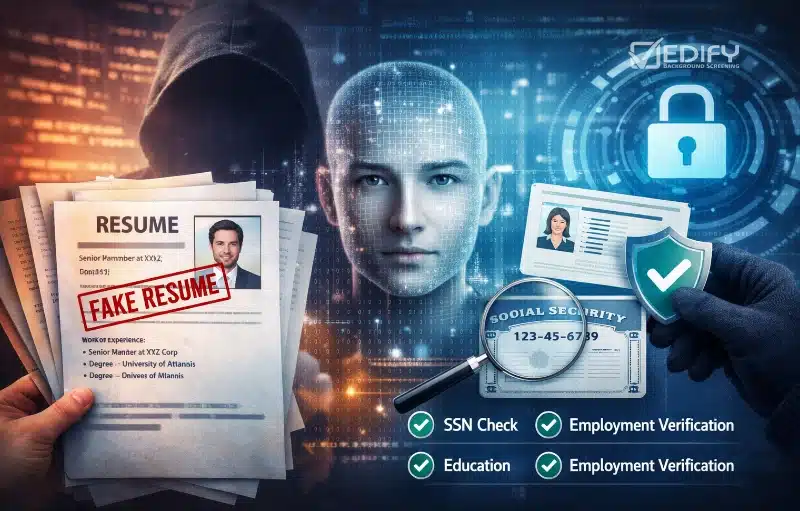
Everybody knows AI can hallucinate. The hiring problem is what happens when a candidate uses AI to hallucinate for them. Suddenly the resume looks polished, the job titles sound right, the school name feels familiar, and the remote interview seems perfectly normal. That is why modern FCRA-compliant employment background checks need to do more than skim a resume. They need to help you verify whether the person, the experience, and the credentials are actually real.
What to Know
- AI can make fake experience, fake employers, and fake education look clean, confident, and believable.
- A Google search and a recruiter gut check are not the same thing as identity, employment, and education verification.
- The fix is a truth layer in your hiring process: digital identity verification for hiring, SSN trace checks, employment verification, and source-verified education checks.
AI Can Hallucinate an Entire Candidate
Takeaway: The new hiring risk is not just a better-written resume. It is a more believable fiction.
AI does not just improve wording. It can help a candidate generate a whole professional story that sounds smooth and complete. A weak bullet becomes a strategic accomplishment. A short contract becomes a leadership role. A partial course list becomes a finished degree. An unverifiable startup suddenly sounds like a fast-growth company you simply have not heard of yet.
That is what makes AI resume fraud detection so important in 2026. The old red flags were easy to spot. Typos. Sloppy formatting. Strange date gaps. Now the opposite can be true. The resume is clean. The language is polished. The interview answers are confident. Recent HR and security reporting has warned that deepfake interview fraud and fake remote hires are moving from edge case to real operational problem, especially in remote and distributed hiring. SHRM has been covering the rise of deepfake interview fraud, and Microsoft has documented cases where fake remote hires slipped past HR and onboarding controls.
The hard part is simple: once AI helps someone tell a believable story, your team needs a way to test whether the story is true.
Fake Employers, Fake Experience, and Fake Degrees Are the New Resume Problem
Takeaway: When an AI-built resume hallucinates, it can hallucinate employers, experience, and education all at once.
Most hiring teams already know candidates may inflate a title or round up a few dates. What is changing is the scale and polish. AI can now help turn small exaggerations into a full synthetic work history. That can show up in a few different ways.
- Fake or synthetic employers. The company name sounds real, but it is a shell business, a dead website, a friend’s side project, or something that cannot be verified through normal channels.
- Fake or inflated experience. A candidate may claim more seniority, broader scope, or responsibilities that do not match what they actually did.
- Fake or synthetic education. The degree may be invented, inflated, or tied to a diploma mill rather than a legitimate institution.
This is where direct-source checks matter. Employment verification helps confirm where a candidate actually worked, what title they held, and when they were employed. Source-verified education checks help confirm whether a degree, diploma, or certification was really earned. The Federal Trade Commission has long warned employers about diploma mills that sell credentials with little or no coursework, because bogus degrees can leave you with an unqualified hire, unnecessary liability, and a very public embarrassment if the claim falls apart later. FTC guidance on fake degrees is still worth reading.
Put plainly, a polished resume is not evidence. It is marketing. Verification is what separates marketing from truth.
Why Google and Gut Checks Break in Remote Hiring
Takeaway: A candidate can look legitimate online and still fail the most basic source checks.
A quick search can tell you whether a company name appears on the internet. It cannot tell you whether the candidate really worked there. A LinkedIn profile can look complete and still be wrong. A school can sound legitimate and still be unaccredited. A video interview can feel normal and still leave you talking to the wrong person.
That is why “looks legit” is no longer enough, especially when you are trying to figure out how to verify remote employees. Manual review checks presentation. Verification checks facts. Those are not the same thing.
One practical place to start is with SSN trace checks. A Social Security trace helps surface names, aliases, and address history associated with the SSN so you can spot identity discrepancies early and make downstream searches more accurate. It is useful, but it is not magic. An SSN trace is a foundation, not a full identity decision. If names, aliases, or address history do not line up cleanly, that mismatch is exactly the kind of signal your hiring team should pause on before moving forward.
Quick Reality Check
A Google search helps you find what is visible. A verification workflow helps you find what is true.

Digital Identity Verification for Hiring Is the Truth Layer
Takeaway: The best defense is a layered process that verifies the person, the work history, and the credential.
If you want a practical answer to AI resume fraud detection, it is this: add a truth layer to your hiring stack. In remote hiring, that usually starts with digital identity verification for hiring. EDIFY’s remote hiring guidance explains it simply. Digital identity verification helps confirm that the person being hired is who they claim to be, which reduces identity fraud risk before day one.
From there, the process gets stronger when you stack the right checks in the right order:
- Digital identity verification to confirm the person behind the application and interview.
- SSN trace and discrepancy review to surface alias names, address history, and mismatch signals.
- Employment verification to confirm employers, dates, titles, and rehire details when available.
- Education verification to confirm the school, degree, dates, and graduation status directly with the issuing institution.
This layered approach lines up with the broader direction of digital identity best practices. NIST’s current digital identity guidelines focus on identity proofing and authentication for people interacting over networks, which is exactly why identity checks matter more when you hire remotely, hire quickly, or hire for sensitive access.
Need a stronger truth check?
If your team is hiring remote employees, contractors, or access-sensitive roles, a layered workflow can catch what a resume review misses. That is where identity verification, SSN trace data, employment verification, and source-verified education checks work better together than they do alone.
How to Verify Remote Employees Without Slowing Down Hiring
Takeaway: You do not need a bloated process. You need a repeatable one.
One reason teams skip deeper verification is that they assume it will create friction. It does not have to. The goal is not to turn every hire into a months-long investigation. The goal is to build a clean, repeatable process that matches role risk.
A simple workflow looks like this:
- Collect the application, disclosure, and authorization before screening.
- Run digital identity checks and review SSN-based discrepancy signals early.
- Verify employment directly when experience matters to the role.
- Verify education directly when degrees, diplomas, or certifications matter to the role.
- Escalate only the mismatches that actually affect trust, qualifications, or access risk.
This is especially useful for remote teams where you cannot rely on in-person document review, hallway intuition, or office references. It is also a smart fit for small and mid-sized businesses that need a consistent process without building an enterprise-sized compliance department. Keep the workflow simple. Use the same role-based standards for similar jobs. Document your process. Then train managers not to confuse a polished online presence with proof.
One more point matters here: if you use AI anywhere in your hiring process, fairness rules still apply. The EEOC has made clear that federal anti-discrimination laws still apply when AI tools are used in employment decisions. In other words, smarter fraud controls should make your process stronger, not sloppier.
Peace of Mind Is the Real Product
Takeaway: What you are really buying is confidence that the person you hire is the person you screened.
The biggest value here is not just catching one bad actor. It is giving your team peace of mind. Peace of mind that the remote engineer really worked where they said they did. Peace of mind that the degree is real. Peace of mind that the candidate on the call is the same person moving through onboarding. Peace of mind that your hiring process is based on facts, not vibes.
That is why EDIFY fits naturally as the truth layer in your hiring stack. You are not just buying another checkbox. You are building a process that helps you trust what is real before you hand over access, data, customer relationships, or sensitive systems.
If your team wants a cleaner way to verify remote employees and reduce AI-driven resume fraud, book a demo of EDIFY’s identity verification technology and verification workflow, then see our background check pricing to compare the right fit for your hiring process.
Frequently Asked Questions
Q: What is AI resume fraud detection?
A: AI resume fraud detection is the process of identifying inflated, fabricated, or misleading resume claims that may be assisted by AI tools. The strongest approach combines digital identity verification, employment verification, education verification, and discrepancy review instead of relying on writing style alone. Start with the checks that matter most for the role and build from there.
Q: How do you verify remote employees before hire?
A: You verify remote employees by confirming identity first, then validating the facts that matter most for the role, such as prior employers, job dates, degrees, licenses, or certifications. A layered workflow is usually more reliable than any single check. Use a repeatable process and review higher-risk roles more closely.
Q: Can an SSN trace prove a candidate’s identity?
A: No. An SSN trace helps surface names, aliases, and address history associated with the SSN, which makes it useful for spotting discrepancies and improving search accuracy. It should be treated as a foundation, not a final answer. Pair it with identity verification and other source checks when the role carries real risk.
Q: How to verify whether a past employer is real?
A: Usually by verifying the company and the candidate’s relationship to it by contacting the employer directly or using documented verification channels. That helps confirm titles, dates, and sometimes rehire eligibility. When the employer itself is hard to verify, that is a sign to slow down and gather stronger evidence before moving forward.
Q: How do education checks catch fake or inflated degrees?
A: Education checks work by confirming the claimed credential directly with the issuing institution or authorized records source. That helps catch invented degrees, degree inflation, and diploma mill problems that a resume review or internet search may miss. If the role requires a credential, make source verification part of the standard workflow.
Compliance Note
- Get clear disclosure and written authorization before ordering employment screening reports.
- Use the same role-based verification workflow for similarly situated candidates to reduce discrimination risk.
- If report information may affect a hiring decision, follow your pre-adverse action, dispute, and adverse action steps carefully.
Authoritative Sources