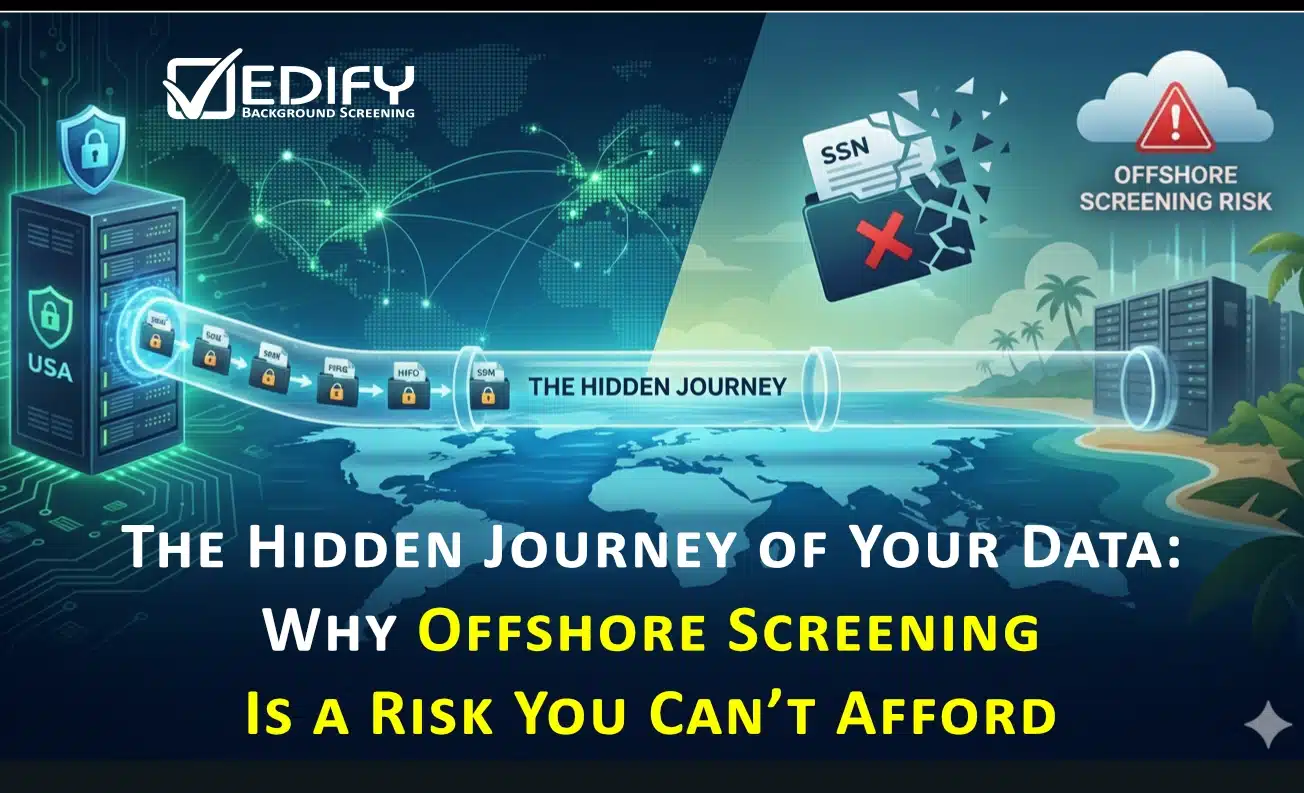
The Hidden Journey of Your Data: Why Offshore Screening Is a Risk You Can’t Afford
When you click “order” on a background check, you picture a secure team doing the work right here in the U.S. The truth? With many large providers, your candidate’s Social Security number, driver’s license data, address history, court records, employment data, and other records may take a long trip overseas for manual “processing.” In this post, we’ll break down how that happens, why it’s risky, and how keeping screening 100% domestic protects your people and your brand. If you want a partner that keeps compliance first, see our FCRA-compliant employment background checks.
Quick Summary
- Offshore “processing” creates avoidable risks: data exposure, accuracy errors, and compliance headaches.
- FCRA requires maximum possible accuracy for public-record data; sloppy workflows and sub-subcontractors can undermine that standard.
- EDIFY keeps screening 100% domestic for tighter security, faster answers, and better accountability.
I. The Invisible Side of Background Checks
Most HR teams expect a straight line: order → verify → results. In reality, many vendors send raw data to offshore teams for indexing, data entry, and processing. That may cut costs, but it widens the threat surface and introduces communication gaps.
Takeaway: The cheapest workflow isn’t the safest. The farther your data travels, the more points of failure you inherit.
II. The “Round Trip”: How Offshore Outsourcing Works
Here’s the typical loop:
- Data is collected in the U.S. (personally identifiable information (PII), identifiers, past addresses, employment data, county targets).
- Files are transmitted to an overseas processing hub for manual entry or “indexing.”
- Results come back to the U.S. provider and are assembled into a report.
The biggest blind spot is the sub-subcontractor chain. You hire a brand-name provider, they hire a vendor, and that vendor quietly hires another firm offshore.
The Economic Reality of Offshore Risk: In major outsourcing hubs like India, a data processing clerk may earn an average of $2.25 per hour. Meanwhile, on the dark web, a single ‘Fullz’ record—a candidate’s complete identity including their SSN, date of birth, and address—can sell for $10 to $50 or more. When you offshore your screening, you aren’t just sending data; you are handing a ‘lottery ticket’ worth forty times their hourly wage to a contracted employee who is beyond the reach of U.S. law. At EDIFY Screening, we eliminate this temptation entirely by keeping 100% of our operations—and your data—within the United States.”
Takeaway: If your vendor can’t name every entity touching your data, that’s a risk—not a feature.
III. The 3 Major Risks of Overseas Data Processing
1) Data Security & Privacy Gaps
Once data leaves U.S. jurisdiction, you can’t count on the same enforcement, audit trails, or breach recourse. And the human factor is real: high-volume support centers are prime targets for social engineering and bribery. Recent reporting tied a major breach to overseas support agents who accessed and photographed sensitive customer data—an expensive lesson in third-party risk. See coverage from Reuters and mainstream tech press such as The Verge.
- Require written attestations about data residency and no offshoring—ever.
- Mandate least-privilege access, MFA, screen-capture controls, and session logging.
- Audit all subcontractors annually. No unknown hands.
Takeaway: You can’t outsource accountability. The more hands in the pot, the more you have to monitor.
2) Accuracy and Cultural Context
U.S. court records are nuanced. The difference between “dismissed,” “nolle prossed,” and “convicted” matters a lot. Non-expert or non-native readers can misinterpret dispositions, miss identifiers, or over-report old or expunged data. That’s exactly what the Consumer Financial Protection Bureau warns against in its advisory opinion on public records and “maximum possible accuracy.”
Takeaway: Accuracy isn’t just a promise. It’s a procedure. Local context and source confirmation protect you from false positives.
3) Compliance & FCRA Liability
The FCRA requires consumer reporting agencies to use reasonable procedures to assure “maximum possible accuracy.” If your vendor’s process leads to duplicative, outdated, or context-free data, the liability can land on you. Layer in EEOC expectations (like considering job relatedness and time since offense), and you’ve got a compliance minefield if the pipeline is sloppy. See the CFPB’s notice above, the EEOC’s criminal records guidance, and the FTC/EEOC joint guidance for employers here (PDF).
Takeaway: Compliance isn’t optional. If accuracy slips, adverse action and litigation risk goes up.
IV. The EDIFY Difference: 100% Domestic, 100% Secure
At EDIFY, we believe people matter more than profits. That starts with how we handle their data. We don’t offshore processing. Our team in Greensboro, NC manages data entry, research, verifications, customer support, and quality assurance—all here in the United States.
- Direct accountability: You can speak with the person working your file.
- Higher accuracy: We confirm database “hits” at the originating source and require multiple identifiers before reporting criminal records.
- Faster resolution: No “overseas hours.” Your team gets real-time updates and quick answers.
Client-facing materials detail our FCRA training, source confirmation, and QA review on every report. (EDIFY resources: What Makes EDIFY Screening Different and How Your Provider Stacks Up.)
V. Transparency: A Modern Requirement for Hiring
Today’s candidates are more privacy-aware than ever. Telling them their SSN and records never leave the U.S. builds trust and reduces drop-off. It also makes your compliance conversations simpler.
A quick vendor-vetting checklist:
- “Do any subcontractors process data outside the U.S.?” (Require a written no-offshoring attestation.)
- “How do you prevent duplicative, expunged, or incomplete court data from appearing in reports?”
- “Do you have US based personnel reviewing ever record before it is released to a client?”
Takeaway: Transparency is a feature your candidates and counsel both appreciate.
FAQ
Q: Is it illegal for background data to be processed overseas?
A: Not automatically. But it multiplies your risk. You’re still responsible for FCRA and EEOC compliance, and you must protect candidate data. If an offshore chain introduces errors or exposure, you carry the brand and legal damage. Next step: ask your vendor for a written no-offshoring attestation.
Q: How do I verify whether my provider offshores?
A: Ask for a full data flow diagram and a current vendor list, including any sub-processors. Require annual attestation that no entity stores or handles your data outside the U.S. If they can’t or won’t, that’s your signal to switch.
Q: What does “maximum possible accuracy” actually require?
A: Procedures that prevent duplicative, expunged, or context-free records from appearing in reports, with clear dispositions. Next step: confirm your provider’s source-confirmation policy.
Q: If a report has an error, who’s liable—me or the vendor?
A: Both can be exposed, depending on the facts. Employers are responsible for how they use reports; CRAs are responsible for accuracy procedures. Follow the FCRA adverse action steps if something looks off. Next step: enable automated pre-adverse and adverse action letters.
Conclusion
Background screening is about trust. You can’t build a trustworthy team with a process that hides where your data goes. Keep your candidate information here at home, handled by trained experts who know U.S. courts and U.S. compliance.
See our background check pricing and get a domestic, compliant program you can defend.
Compliance Notes
- Follow FCRA adverse action steps for any decision based in whole or part on a report (pre-adverse, waiting period, final notice).
- Align criminal record use with EEOC guidance (job relatedness, time since offense, individualized assessment).
- Document accuracy procedures that meet the CFPB’s expectations for public-record data (dispositions, avoiding duplicates/expunged records).
Related Terms
Authoritative Sources