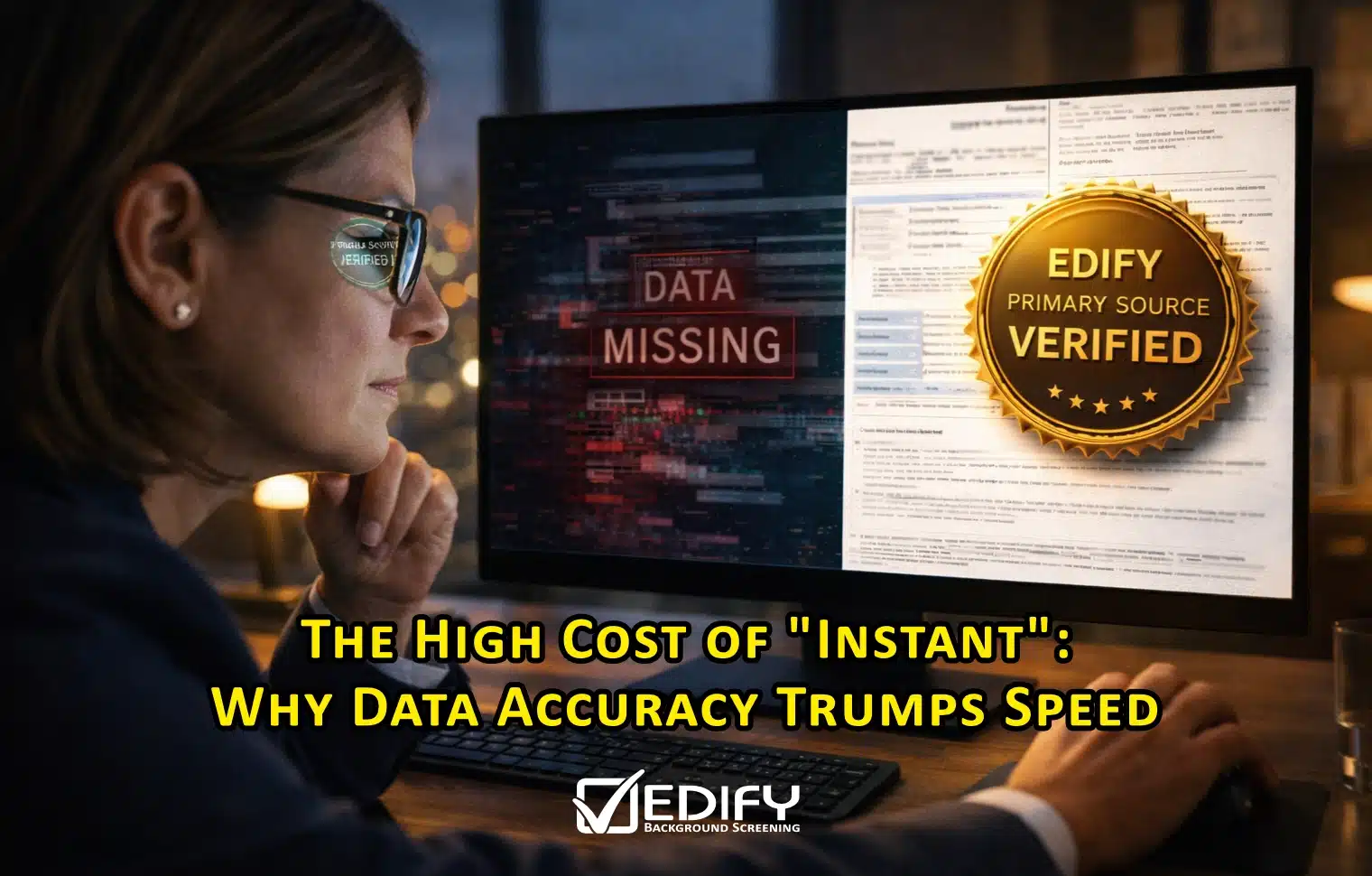
The High Cost of “Instant”: Why Data Accuracy Trumps Speed in Background Screening
You’re trying to hire fast. Managers want someone in the seat yesterday, and “instant background checks” sound like the perfect solution.
But in the real world, speed without accuracy can cost you way more than it saves. If you’re running background checks for hiring, the goal is not a quick PDF. It’s hiring-ready information you can trust.
Key Takeaways
- “Instant” usually means a database snapshot, not a real-time courthouse verification.
- A “clean” report is not proof of a clean record if the search never reached the right source.
- Inaccurate or incomplete data creates real risk for compliance, safety, and turnover costs.
- The smartest approach blends speed with verification: use databases for pointer data, then confirm at the source.
The modern hiring dilemma: speed feels like safety
In a 1-click world, it’s easy to assume “faster” means “better.” Especially when you’re juggling open roles, tight schedules,
and pressure to onboard quickly.
Here’s the problem: in background screening, fast results can be misleading. A report can come back quickly and look “clean,”
even if it missed the jurisdiction where the record actually lives.
Takeaway: Speed is nice, but accuracy is what actually protects you.
The “national database” myth: what “instant” usually pulls from
Let’s clear up a common misconception: there is not one single, real-time “national criminal database” that reliably captures
everything across every court in the country. The U.S. has thousands of jurisdictions, and records are created, updated, and reported
differently depending on the court.
Many “instant” checks are really database searches. Think of these as big collections of records pulled from multiple sources at different
times. They can be helpful, but they’re not the same as going to the primary source (the courthouse record) and confirming what’s current and complete.
Important nuance: database searches do have a place in screening when they’re used the right way.
They can provide pointer information, meaning they help flag potential records or jurisdictions that may need a closer look.
The key is what happens next: if a database suggests a possible match, a quality screening process verifies it at the source
before you make a hiring decision.
Here’s the gap you need to watch for: if a candidate had a case filed or updated recently in a county court, a database snapshot may not reflect it yet.
A primary source search, verified at the courthouse level, is built to catch what’s actually on file.
Takeaway: “Instant” often means “not fully sourced.”
Instant scrapes vs. EDIFY verified searches (quick comparison)
| What you’re comparing | “Instant” database scrapes | EDIFY Screening verified searches |
|---|---|---|
| Primary data source | Aggregated databases (snapshots) | Courthouse / primary source verification where it matters most |
| Freshness | Varies widely by source and update schedules | Built to reflect current court records and confirmed details |
| “Clean” result meaning | May just mean the database did not contain the record | Means the relevant jurisdictions were actually searched and verified |
| Hit handling | Possible “hits” can be incomplete, misattributed, or missing dispositions | Potential matches are verified at the source before action |
| Compliance workflow support | Often limited to “data delivery” | Designed to support compliant decision-making, including adverse action steps |
| Best use case | Pointer data (where to look next) | Hiring decisions that need accuracy you can defend |
If your provider can’t clearly explain (1) where the data comes from, and (2) how “hits” are verified, you’re not buying certainty.
You’re buying speed and hoping it’s right.
Takeaway: If your provider can’t explain the source and verification, you’re guessing.
The three risks of inaccurate background check data
A) Compliance risk (FCRA): accuracy is a legal expectation
Employment background checks are regulated. Under the Fair Credit Reporting Act (FCRA), consumer reporting agencies are expected to
follow reasonable procedures designed to assure “maximum possible accuracy” of consumer report information. If a screening process relies on
unverified or incomplete public record data, that’s where problems start.
A clean compliance workflow also matters when you take action based on a report. If something in the report could impact your decision,
you need a process that supports required steps like pre-adverse and adverse action notices.
For a clear employer overview, see the joint FTC/EEOC guidance:
Background Checks: What Employers Need to Know.
Takeaway: Fast reports are useless if they create compliance exposure.
B) Workplace safety risk: what you miss becomes your problem
If a search misses a recent violent offense, theft, or another job-relevant record, you’re not just dealing with a “data issue.”
You’re taking on a workplace risk. And in safety-sensitive roles, that can become a serious incident fast.
This is also where “fair chance” best practices matter. The EEOC guidance encourages thoughtful, job-related decision-making when criminal records are involved:
EEOC Enforcement Guidance (Arrest and Conviction Records).
Takeaway: Your team’s safety depends on what your screening actually finds.
C) Hidden cost risk: “cheap” checks can get expensive quickly
The $20 you “saved” on a bargain report disappears the moment you deal with a bad hire. Turnover, retraining, management time, productivity loss,
schedule disruption, and potential claims add up. Even one miss can cost far more than a thorough screening process.
Takeaway: The cheapest check is often the most expensive outcome.
The EDIFY difference: fast where it counts, verified where it matters
Here’s the sweet spot: you can move quickly without sacrificing accuracy. The point is not to reject technology. It’s to use it correctly.
- Smart sourcing: Use databases as pointer tools, then verify at the primary source to confirm details that matter.
- Human review: When something looks like a match, you want a process that confirms the record, the identifiers, and the disposition.
- Compliance-first workflow: Screening should support consent, permissible purpose, and adverse action steps when needed.
If you want plain-language definitions for the terms that usually get glossed over, these quick references help:
Criminal Database Search,
County Criminal Search, and
CRA (Consumer Reporting Agency).
Takeaway: You’re not buying data. You’re buying a decision you can stand behind.
The Background Screening Quality Audit (10-point checklist)
Want a quick way to audit your current provider? Use this checklist. If you can’t get clear “yes” answers, your screening program may be weaker than it looks.
- Source clarity: Can the provider explain exactly where criminal data comes from?
- Verification policy: Are potential matches verified at the courthouse/source before you take action?
- Update frequency: How often are database records refreshed, and what jurisdictions are limited?
- Disposition handling: Does the report include outcomes (dismissed, reduced, completed diversion), not just charges?
- Identity matching: What identifiers are used to avoid false positives?
- Jurisdiction coverage: Does the process actually search the counties where the candidate lived and worked?
- Dispute process: Is there a documented reinvestigation workflow and timeline?
- Adverse action support: Can the system support pre-adverse and adverse action steps?
- Documentation: Can you easily show consent and compliant handling if audited?
- Turnaround reality: Are timelines honest about what’s instant vs what’s verified?
If you find gaps, don’t panic. Just tighten the process. A small adjustment in quality can reduce a lot of risk.

FREQUENTLY ASKED QUESTIONS ABOUT BACKGROUND SCREENING

Q: What’s the difference between an “instant” background check and a verified check?
A: Instant checks usually pull from aggregated databases and public repositories that can be incomplete, out of date, or missing key details like dispositions. Verified checks confirm records at the primary source (often the courthouse) so you’re making a decision based on what’s actually on file, not just what happened to be in a snapshot. Pro Tip: ask your provider which searches are database-only vs. verified at the source before you rely on the result.
Q: Are database criminal searches useless?
A: Not at all. Database searches are useful for pointer information, meaning they can help flag possible records or jurisdictions that deserve a closer look. The risk is treating a database result as the final answer without verifying the record at the source. Pro Tip: ask what happens after a database “hit” and whether the provider confirms matches to official court records.
Q: Why do “instant” checks OFTEN miss records?
A: Because many “instant” checks are only scraping electronic data from public repositories and aggregated databases. Those sources typically cover only a small fraction of the entire court system across the country, and they update on schedules that vary by jurisdiction. If a case was filed recently, updated, or has a new disposition, it may not appear in that electronic snapshot yet. Pro Tip: ask whether databases are used as pointer data and then verified at the courthouse before you make a hiring decision.
Q: What does “verified at the source” mean in plain English?
A: It means confirming the record with the original record holder (usually a courthouse) to validate the person match, the charges, and the final outcome. That’s how you avoid acting on incomplete, stale, or misattributed data. Pro Tip: request your provider’s written source-verification policy for public records.
Q: What’s a “false positive” and why should I care?
A: A false positive is when a record is incorrectly matched to a candidate with a similar name or date of birth. It wastes time, creates legal risk, and can lead to unfair decisions. A professional background check reduces this risk by using multiple identifiers and matching the information back to official court records, so the record reported actually belongs to the applicant. Pro Tip: ask what identifiers and matching rules your provider uses, and whether they verify potential matches to the source record.
Q: If accuracy is the priority, will verified checks take too long?
A: Not necessarily. Many jurisdictions support fast access, and strong providers use technology to move quickly while still verifying records when needed. The real goal is fast plus defensible, not fast plus vague. Pro Tip: ask for typical turnaround times by search type and what triggers source verification.
Q: What are the biggest compliance risks with “instant” background checks?
A: The biggest risk is making decisions using incomplete, outdated, or unverified public record information, especially if your process does not support required notices and documentation. Pro Tip: confirm your workflow supports pre-adverse action, a reasonable waiting period, and final adverse action steps when applicable.
Q: Do I need to send adverse action notices if I decide not to hire someone?
A: Yes. If you used a third-party background check (a consumer report) and information in it contributed to your decision, adverse action steps apply under the FCRA. Pro Tip: check your process against the FTC’s employer guidance on background checks.
Q: What should I do if a candidate disputes the report?
A: Pause the decision and follow the provider’s dispute and reinvestigation process. A reputable CRA should have a documented workflow to review the claim, re-check sources, and correct errors when needed. Pro Tip: ask your provider exactly how disputes are handled, what documentation you’ll receive, and the expected timeline.
Q: How do I know if my current provider is “good enough”?
A: If you can’t get clear answers on data sources, verification, identity matching, dispute handling, and adverse action support, you’re taking on unnecessary risk. Pro Tip: run the 10-point Quality Audit and make your provider show you (in writing) how each item is handled.