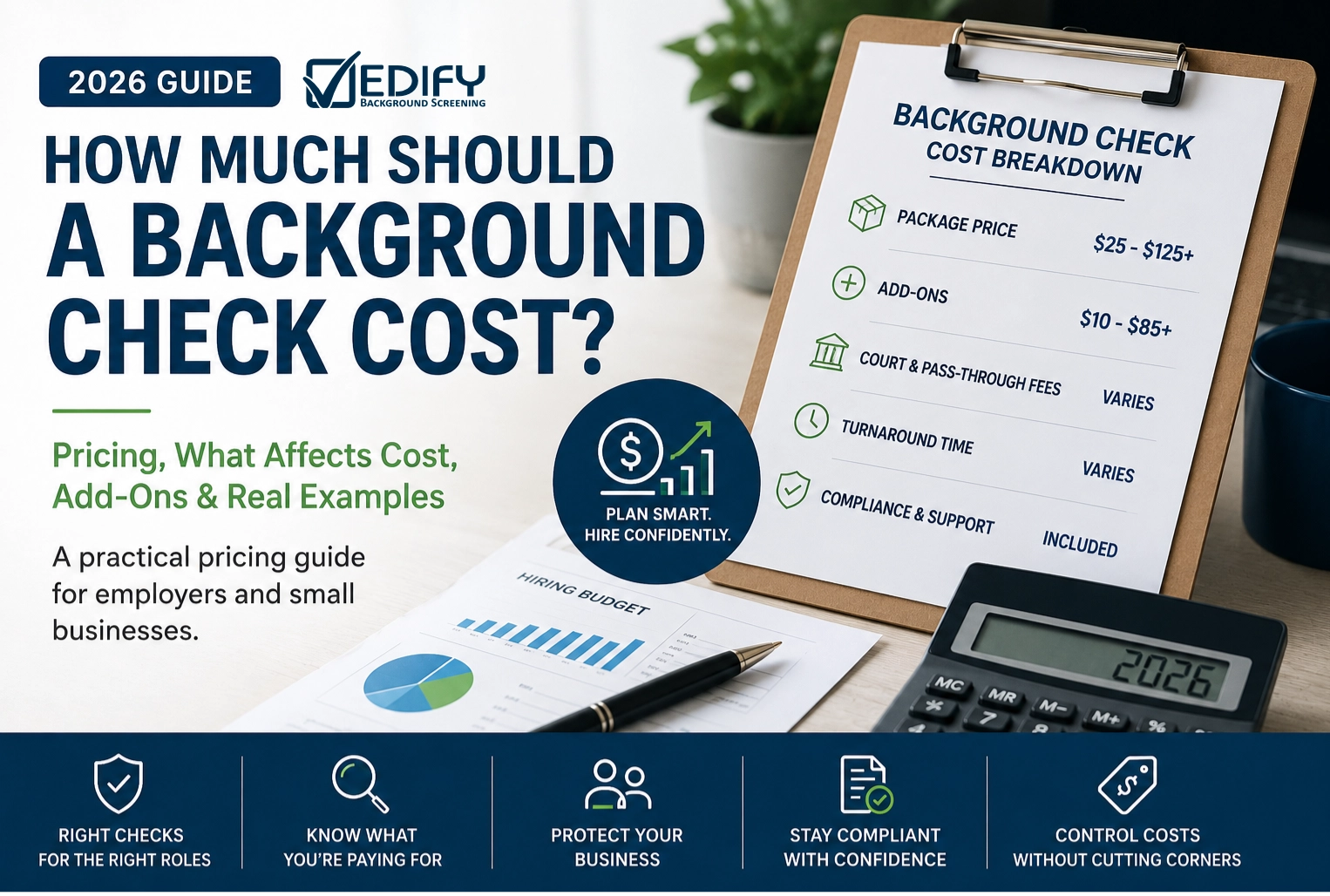
How Much Should a Background Check Cost in 2026? A Practical Guide for Employers
If you are trying to budget for background checks in 2026, you are probably looking for a straight answer. The problem is that background check pricing depends on the type of role, the searches included, where the applicant has lived, and whether you need add-ons like drug testing, motor vehicle reports, employment verification, or education verification.
For small and mid-sized businesses, the goal should not be to buy the cheapest report possible. The goal is to build a screening process that is affordable, consistent, compliant, and appropriate for the job. This guide breaks down common pricing ranges, what affects cost, where court and pass-through fees come from, and how to think about background check pricing without overbuying or under-screening.
Quick Summary
- In 2026, basic employment background check packages commonly start around $25 to $50 per applicant.
- Standard employment screening packages often fall around $50 to $75 per applicant.
- More complete professional or higher-risk packages often fall around $80 to $125+ before pass-through fees or role-specific add-ons.
- Common add-ons include MVRs, drug screening, education verification, employment verification, professional license checks, credit reports, and civil searches.
- Court and pass-through fees are usually not hidden. They may simply be unknown until the applicant’s address history or search results show which sources must be checked.
1) Quick Answer: What Should Employers Expect to Pay?
Most small businesses can think about background check pricing in three general levels: basic, standard, and professional. The right level depends on the risk and responsibility of the role.
A low-risk seasonal or support role may only need a basic package. A front-line employee who works with customers, property, inventory, or company operations may need a deeper package. A manager, bookkeeper, caregiver, driver, regulated employee, or professional hire may need broader screening and verification.
| Package Type | Typical 2026 Planning Range | Common Use Case | What It Often Includes |
|---|---|---|---|
| Basic / Core Package | $25 to $45 | Low-risk, entry-level, seasonal, retail, or basic support roles | SSN trace, address history, sex offender registry, watchlists, national criminal database |
| Standard / Plus Package | $50 to $75 | Front-line, client-facing, safety-sensitive, operations, and field roles | Basic package items plus deeper county, statewide, or 7-year criminal coverage |
| Professional / Pro Package | $80 to $125+ | Managers, regulated roles, professional roles, technical roles, financial access, higher responsibility | Standard package items plus federal searches, employment verification, education verification, or other role-based checks |
Takeaway: Most employers should expect to pay more for higher-risk roles because those roles require deeper searches. Pricing should follow job responsibility, not a one-size-fits-all checklist.
2) Why Background Check Prices Vary So Much
Two employers can order a “background check” and receive very different products and prices. One may be a simple database search. Another may include county courthouse searches, federal criminal records, address-history-based coverage, employment verification, education verification, drug screening, and adverse action support.
That is why advertised prices can be hard to compare. The package name matters less than what is actually included.
Common price drivers include:
- Search depth: National database, county, statewide, federal district, and federal statewide searches all have different costs and purposes.
- Applicant address history: A candidate who has lived in several counties or states may require more research than someone with one long-term address.
- Aliases and prior names: Maiden names, legal name changes, nicknames, and alternate spellings can affect search coverage.
- Role requirements: Drivers, caregivers, financial staff, managers, and regulated workers often need more screening than lower-risk roles.
- Source fees: Courts, DMVs, schools, employers, licensing boards, and data providers may charge access or processing fees.
- Provider service model: Support, customization, compliance tools, portal access, users, setup fees, and account minimums can affect the real cost of ownership.
Takeaway: Two “background checks” can have very different prices because they may include very different searches. Always compare the contents, not just the headline price.
3) What a Basic, Standard, and Professional Package Usually Includes
A basic package is often used for lower-risk roles where the employer wants a cost-conscious screen that covers identity-related search logic, national database records, sex offender registry data, and watchlists. This can be a reasonable fit for some seasonal, entry-level, or supervised positions.
A standard package usually adds deeper criminal coverage. This often includes county or statewide searches tied to address history. For small business background checks, this is where many employers land because it balances price and due diligence for common hiring situations.
A professional package is built for roles with more trust, access, risk, or responsibility. These may include management roles, professional services, regulated positions, financial access, technical access, or roles where employment and education history matter. These packages often add federal criminal searches and verification services.
| Package Level | Good Fit For | Common Components |
|---|---|---|
| Basic / Core | Lower-risk, supervised, seasonal, or entry-level roles | SSN trace, address history, sex offender registry, watchlists, national criminal database |
| Standard / Plus | Customer-facing, operations, retail, field-service, and safety-sensitive roles | Basic components plus county, statewide, or 7-year criminal history coverage |
| Professional / Pro | Managers, regulated roles, technical roles, professional services, financial access | Standard components plus federal searches, employment verification, education verification, license verification, or credit where legally allowed |
Takeaway: The right package depends on the risk and responsibility of the job. A better screening program starts by grouping roles into risk levels, then matching each level to the right searches.
4) Common Add-Ons and What They Usually Cost
Add-ons are not automatically “extra.” Sometimes they are exactly what makes a background check appropriate for the role. A driver may need an MVR. A caregiver may need healthcare sanctions screening. A bookkeeper may need an employment credit report where legally allowed. A professional hire may need education or license verification.
Use the ranges below as planning estimates. Exact pricing can vary by provider, jurisdiction, package structure, and pass-through fees.
| Add-On | Typical Planning Range | Why Employers Add It |
|---|---|---|
| County Criminal Search | $10 to $30 per county/search | To search local court records where many criminal records originate |
| 7-Year County Criminal Search | $20 to $40+ | To cover counties tied to a candidate’s recent address history |
| Statewide Criminal Search | $15 to $35 per state | To broaden coverage where reliable statewide data is available |
| Federal Criminal Search | $10 to $35 per search | To check federal cases that may not appear in county or state criminal searches |
| Motor Vehicle Report | $10 to $25 per report, plus possible DMV fees | For employees who drive for work or operate company vehicles |
| Education Verification | $15 to $35 per school/degree | To confirm degrees, diplomas, certificates, or claimed education history |
| Employment Verification | $15 to $35 per employer | To confirm previous employers, dates, titles, or work history |
| Professional License Verification | $15 to $35 per license | For regulated, licensed, or credentialed roles |
| Employment Credit Report | $15 to $35 | For financial responsibility roles where legally allowed and job-related |
| Drug Screening | $50 to $85+ | For safety-sensitive, regulated, or drug-free workplace roles |
| Healthcare Sanctions / FACIS-Type Search | $8 to $30+ | For healthcare, caregiving, clinical, or regulated care roles |
| Civil Records Search | $20 to $50+ | For executives, financial access, high-trust roles, or business-sensitive positions |
Takeaway: Add-ons are not “extras” when the role actually requires them. They become wasteful only when they are added without a clear job-related reason.
5) Court and Pass-Through Fees: Why the Final Cost Can Vary
Some background check costs cannot be known with certainty before the report is ordered. That does not mean the provider is hiding fees. In many cases, courts, DMVs, schools, employers, licensing boards, or third-party verification sources set their own access or processing fees.
Those fees can vary by jurisdiction and may only become clear once the applicant’s history tells the provider where to search. For example, a candidate’s address history may show that county court searches are needed in multiple jurisdictions. One county may have no access fee, while another may charge for court access, record retrieval, copies, or researcher time.
Common pass-through or variable fees can include:
- Court access fees: Charged by county, statewide, or federal court sources.
- DMV fees: Charged by state motor vehicle departments for MVRs.
- School or clearinghouse fees: Charged for education verification.
- Employer or third-party verification fees: Charged by verification platforms or former employers.
- Licensing board fees: Charged by credentialing or licensing sources.
- Researcher fees: Needed in jurisdictions that require manual research or courthouse retrieval.
- Database hit verification costs: Needed when a possible record must be confirmed at the originating source before reporting.
The key is transparency. A trustworthy provider should explain when these fees may apply, why they apply, and how they appear on your invoice.
Takeaway: Pass-through fees are not always avoidable, but they should be explained clearly, itemized when possible, and tied to the specific search being performed.
6) Other Cost-of-Ownership Factors Beyond the Report Price
The per-report price matters, but it is not the whole cost. Small and Medium sized businesses should also pay attention to account terms, support, workflows, and the amount of time their team spends managing the process.
Before choosing a provider, ask about:
- Setup fees
- Monthly minimums
- Annual commitments
- Long-term contracts
- Extra user fees
- Platform or portal fees
- Applicant invitation tools
- Digital disclosure and authorization forms
- Adverse action support
- Turnaround time communication
- Whether support is US-based, outsourced, phone-based, or email-only
- Whether packages can be customized to match how your business operates
A slightly cheaper report may not save money if your team spends extra time chasing updates, correcting applicant information, trying to understand a report, or figuring out the next compliance step on its own.
Takeaway: The real cost is the report price plus the time, fees, and risk required to use it correctly. For busy HR teams and business owners, service matters because time matters.
7) Examples: Matching Screening Packages to Common Hiring Situations
One of the best ways to control background check costs is to match your package to the role. That keeps you from under-screening higher-risk jobs or overpaying for lower-risk ones.
| Hiring Situation | Suggested Package Type | Common Add-Ons to Consider |
|---|---|---|
| Seasonal or low-risk support employee | Basic / Core | Usually none unless the role has special access or safety concerns |
| Retail or front-line employee | Standard / Plus | County criminal coverage, drug screening for safety-sensitive roles, MVR if driving is required. For high-volume hiring, see retail employee screening. |
| Driver or delivery role | Standard / Plus | MVR, drug screening, DOT-related services if applicable |
| Office or administrative employee | Basic / Core or Standard / Plus | Employment verification if experience matters, credit only where legally allowed and job-related |
| Manager or employee with financial access | Professional / Pro | Employment verification, education verification, credit where legally allowed, civil records where appropriate |
| Healthcare or caregiver role | Standard / Plus or Professional / Pro | Healthcare sanctions, license verification, drug screening, employment verification. Learn more about caregiver background checks. |
| Professional services role | Professional / Pro | Employment verification, education verification, license verification, credit where legally allowed |
Takeaway: Build screening around job risk, not a one-size-fits-all package. The cleanest pricing strategy is a consistent package structure for each role type.
Need help choosing a right-sized package?
A role-based screening package can help you control cost while still protecting your business. Start by grouping roles by responsibility, then decide which searches each group really needs.

8) A Transparent Pricing Example: EDIFY Core, Plus, and Pro
To make the pricing ranges above more concrete, here is one example of how a provider can structure packages by role risk. EDIFY publishes three main background check package levels: Core, Plus, and Pro.
| EDIFY Package | Published Price | Best Fit | Included Searches |
|---|---|---|---|
| Core | $25.95 per applicant | Low-risk, cost-conscious roles | SSN Trace with 7-year address history and AKA listing, Nationwide Sex Offender Registry including AKAs, Security Watchlists including AKAs, Nationwide Criminal Database including AKAs |
| Plus | $54.95 per applicant | Client-facing, front-line, key operations, and safety-sensitive roles | Core items plus unlimited county criminal search based on 7-year address history and federal statewide criminal search based on 7-year address history |
| Pro | $84.95 per applicant | Higher-risk, regulated, management, technical, and high-responsibility roles | Plus items, unlimited federal criminal district searches based on 7-year address history, one employment verification, and one education verification |
EDIFY also lists several practical account features that matter for small businesses: US-based support, no outsourcing, no setup fees, no long-term contract, no monthly minimums, no annual commitment, and unlimited users.
Takeaway: Transparent pricing makes it easier to compare packages, budget for hiring, and explain why different roles need different levels of screening.
9) How to Choose the Right Background Check Package
The best package is the one you can explain clearly and apply consistently. A good screening process should match the duties, access, and risk of the job.
Ask these questions before choosing a package:
- Does the role involve customers, children, vulnerable adults, homes, vehicles, money, inventory, or sensitive data?
- Does the person drive for work or operate a company vehicle?
- Does the role require a degree, license, credential, or prior experience?
- Does the employee work with minimal supervision?
- Is the role regulated by federal, state, industry, or insurance requirements?
- Do you need only criminal history, or do you also need employment, education, license, MVR, credit, or drug testing?
- Are you hiring in multiple states with different rules?
- Do you have a clear adverse action process if report information may affect the hiring decision?
- Can your provider explain court fees and pass-through fees before and after the order?
- Can you talk to a real person if something is delayed, unclear, or sensitive?
Takeaway: A good package should be consistent, role-based, compliant, and easy to explain. When your screening process is clear, your hiring decisions get easier.
FAQ
Frequently Asked Questions About Background Check Pricing
Q: How much does a background check cost in 2026?
A: A basic employment background check package commonly starts around $25 to $45. Standard packages often fall around $50 to $75, while professional or higher-risk packages may run $80 to $125+ before pass-through fees or add-ons. Your next step is to match the package to the risk level of the role.
Q: What is the cheapest background check an employer can run?
A: The cheapest option is usually a basic database-driven package. That may be enough for some low-risk roles, but it may not provide enough coverage for roles involving customers, vehicles, financial access, vulnerable populations, or higher responsibility. Your next step is to decide what level of risk the role creates.
Q: Why do county searches cost extra?
A: County searches often require access to local court records, and some courts charge access, copy, retrieval, clerk, or researcher fees. County-level searches are important because most criminal records originate at the county courthouse. Your next step is to ask whether county coverage is included in your package or billed separately.
Q: Are court fees and pass-through fees hidden fees?
A: No, court and pass-through fees are a legitimate part of the overall background check costs; However, they are unknown until the provider knows which courts, DMVs, schools, employers, or licensing boards must be contacted. Your next step is to work with a provider that explains and itemizes these fees clearly.
Q: Do I need an MVR for every employee?
A: No. An MVR usually makes sense when the employee drives for work, operates a company vehicle, transports people or goods, or must meet insurance requirements. Your next step is to identify which roles involve driving and apply the same standard consistently.
Q: When should I add drug testing?
A: Drug testing is commonly used for safety-sensitive roles, regulated positions, transportation roles, manufacturing, healthcare, or workplaces with a formal drug-free workplace policy. Your next step is to make sure your policy is written, consistently applied, and compliant with applicable laws.
Q Are employment and education verifications worth it?
A: Absolutely! With the use of AI today helping applicants create “fiction” resumes verifying experience, credentials, and education are of the utmost importance. They may not be necessary for every position. Your next step is to decide which roles require verified qualifications and which do not.
Q: How can small businesses keep background check costs predictable?
A: Create role-based screening packages, ask about pass-through fees, avoid unnecessary add-ons, use consistent criteria, and choose a provider that helps explain costs before you order. Your next step is to review your current roles and group them into basic, standard, and professional screening levels.
Final Thoughts: Price Matters, But Fit Matters More
In 2026, background check pricing is best understood as a balance between cost, coverage, compliance, and service. A basic package may be perfect for some roles, while other jobs need deeper research, verifications, drug testing, or driving records.
The smartest approach is to build a screening program around the way your business actually hires. If you want a clear starting point, review EDIFY’s package structure and add-on options here: See our background check pricing.
Compliance Note
- Get proper disclosure and written authorization before ordering employment background checks.
- Use pre-adverse and final adverse action steps when background check information may affect a hiring decision.
- Apply screening criteria consistently and consider whether criminal history is job-related for the role.
Related Terms
Internal links inserted: background checks → https://www.edifyscreening.com/general_business_background_checks/; small business background checks → https://www.edifyscreening.com/small_business_background_checks/; retail employee screening → https://www.edifyscreening.com/retail-business_background-checks/; caregiver background checks → https://www.edifyscreening.com/caregiver_background_checks/; See our background check pricing → https://www.edifyscreening.com/background_check_pricing/

The resources provided here are for educational purposes only and do not constitute legal advice. We advise you to consult your own counsel if you have legal questions related to your specific practices and compliance with applicable laws.